
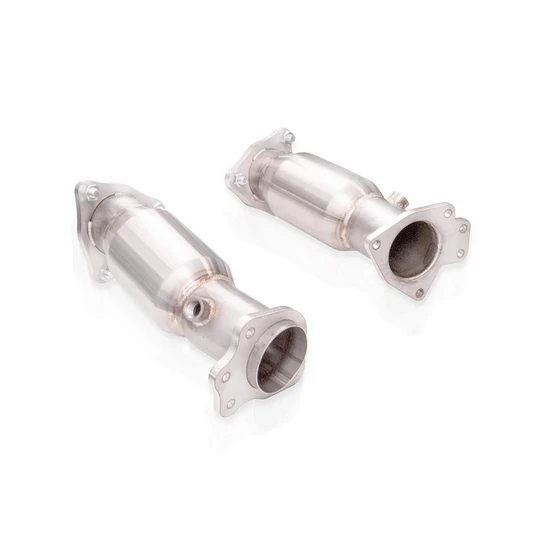
We here at XP Motorsports are fairly often asked, "Can I remove my cats?" for more and better performance!
First, let's qualify that question because we also hear this statement. My state does not have an emission standard or inspection. That is irrelevant since the regulations are federal regulations! If your state, county, or city meets the EPA Federal Air Regulations, they are not required to test vehicles. In many heavily populated states and counties with high industrial production, the air quality may be borderline in meeting the Federal Air Quality standards, and they are then required to test vehicles. Let's start at the beginning!
What actually is a catalytic converter?
A catalytic converter is an exhaust device that changes toxic engine gases into safer gases like water vapor and carbon dioxide. Current-day factory catalytic converters add minimal backpressure and do not significantly hurt performance on stock or moderately tuned daily drivers.
How Modern Catalytic Converters Affect Performance
-
Minimal Restriction: Modern engineering and advanced catalyst designs mean stock catalytic converters create very little exhaust resistance (often just 2 to 3 psi of backpressure)
Intelligent ECU Tuning: Modern engine control units (ECUs) rely on oxygen sensors around the catalytic converter to optimize the air-fuel ratio. Removing or gutting the converter can confuse the computer, sometimes leading to worse efficiency or reduced power rather than a gain.
Why Modern Cats Don't Rob Much Power
-
Better Flow Design: Early catalytic converters from the 1970s and 1980s were massive, highly restrictive bottlenecks. Modern factory cats use optimized shapes and advanced ceramic or metallic matrices that let exhaust gases pass freely.
-
High Output Capacity: Factory exhaust systems are engineered to match the engine's output. For example, high-performance factory cars like the new Chevrolet Corvette ZR1 can produce over 1,000 horsepower while still retaining legal catalytic converters.
-
Exhaust Backpressure Rules: Engines typically lose about 3 horsepower for every 1 pound per square inch (PSI) of backpressure. A properly sized modern catalytic converter creates a very small pressure drop.
High-Flow Cats vs. Stock Cats
A high-flow catalytic converter reduces exhaust backpressure and increases airflow compared to a stock unit, offering minor power gains on modified vehicles while still reducing emissions.
Performance and Flow
-
Stock Cats: Feature a dense internal mesh (high cells per square inch, or CPSI) that heavily restricts exhaust flow to maximize filtering on factory setups
-
High-Flow Cats: Use a wider, more open mesh structure (lower CPSI) that lets exhaust gases escape faster with less resistance
-
Power Gains: On a completely stock engine, a high-flow cat yields negligible horsepower increases. On heavily modified or turbocharged engines, they reduce backpressure, help turbos spool faster, and can unlock noticeable gains when paired with a custom exhaust tune.
Sound, Smell, and Daily Driving
-
Exhaust Note: High-flow cats slightly deepen and amplify the exhaust tone without creating the harsh rasp or drone common with a total cat delete
-
Smell: They scrub enough gas fumes to prevent the raw, heavy fuel odor that occurs when running a completely catless setup.
-
Livability: They provide a great middle ground for street-driven cars by improving flow while keeping the cabin comfortable and reducing highway drone.
Emissions and Legality
-
Stock Cats: Fully compliant with strict factory emission standards and local laws everywhere.
-
High-Flow Cats: Retain core catalytic materials to clean some exhaust gases, helping avoid a check engine light (CEL) and making it easier to pass basic inspections in less restrictive areas—though they may not pass strict CARB/smog tests in states like California
When Do Cats Actually Cost You Power?
-
Clogged or Damaged Units: If a converter becomes melted, damaged, or choked with carbon over time, it acts like a plugged nose. Replacing a failing or clogged cat can instantly restore 10 to 50+ horsepower that the engine was missing.
-
Heavy Modifications: If you heavily upgrade an engine with a bigger turbo or high-performance camshafts, the stock cat might become a restriction. In these cases, switching to a straight pipe or a high-flow aftermarket catalytic converter may yield a small gain of 5 to 15 horsepower at wide-open throttle. On a modern vehicle with a healthy stock catalytic converter, you lose less than 5 to 10 horsepower, and often virtually nothing at all.
What happens if I remove my cats from a modern vehicle?
Removing the catalytic converter (a "cat delete") on a modern vehicle makes the car illegal to drive on public roads, triggers a check engine light, and provides little to no performance benefit. You are in violation of federal regulations!
Vehicle Performance and Mechanical Effects
-
Check engine light: Modern cars use downstream oxygen sensors to monitor the catalytic converter. Removing it causes a fault code (like P0420) that turns on your dashboard light.
-
Poor running condition: Modern engine computers (ECUs) expect specific exhaust backpressure and sensor data. Without them, the car may run poorly or drop in fuel efficiency unless heavily reprogrammed or tuned.
-
Loud noise and smells: Your exhaust note will become much louder and raspier, and a strong, unburnt fuel smell will enter the cabin and tailpipe area.
-
Minimal power gains: While older cars gained power from removing restrictions, modern catalytic converters flow very efficiently. Daily drivers see little to no real horsepower increase without a complete custom engine tune and performance build.
Legal and Environmental Consequences
-
Breaking the law: Federal law under the Clean Air Act prohibits removing or tampering with factory emissions equipment on any vehicle originally built with a catalytic converter. It also voids any manufacturer warranties
- Fines: You can face steep individual fines up to $4,500, and shops that remove them can face fines over $10,000.
- Failed inspections: Your car will automatically fail state emissions and smog tests, preventing you from renewing your vehicle registration.
- More pollution: Without the catalyst, your car will release significantly more toxic gases like carbon monoxide and hydrocarbons into the air. Carbon monoxide and hydrocarbons mix with sunlight and other chemicals to form ground-level (tropospheric) ozone, which traps heat.
In Conclusion
With the advancement in today's engine designs, converter advancements, and direct injection, certain tailpipe emissions like unburned hydrocarbons and carbon dioxide are reduced by delivering fuel with high precision. Advancements in engine tuning have helped reduce emissions by optimizing the combustion process and improving fuel efficiency. Today's modern vehicles produce more horsepower with greatly reduced emissions than at any other time in history. In today's modern vehicles there is absolutely no reason or benefit to removing the catalytic converters!