Big Brake Kit: Do You Actually Need One?
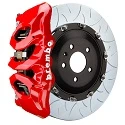
It's one of the most common upgrades in the performance world—but is a big brake kit actually worth it over stock? The answer depends on more than just the hardware under your wheel. Stopping faster and more consistently comes down to six key components working together: caliper size, rotor choice, pad choice, brake fluid, brake lines, and tires. Get all six right, and you'll feel the difference whether you're commuting, carving canyons, or pushing hard on track. Miss one, and even the most expensive brake kit won't perform the way you expect.
Let's break down each component and what it means for your build.
1. Caliper Size
The caliper is what clamps down on your rotor to generate stopping force. More pistons mean more clamping force—and more control over how that force is applied.
-
Single piston—Factory standard on most street cars.
- Reliable and cost-effective for daily driving, but limited when heat and load increase
- Poor pad wear
-
Dual piston—A step up in clamping force and pad wear consistency.
-
A solid upgrade for spirited street driving.
-
4-piston—The sweet spot for enthusiasts and track day drivers.
-
More bite
-
better modulation
-
improved fade resistance
-
even pressure distribution
-
reduced taper wear
-
better heat management
-
6-piston —
-
Built for serious performance.
-
Maximum clamping force for high-speed braking demands on track.
-
provides more consistent and even brake pad wear.
-
Even Pressure: More contact points spread the clamping force uniformly across a larger pad.
-
Staggered Bores: Manufacturers use differential bores (varying piston sizes) to counteract the rotational pull of the brake rotor.
-
Less Tapering: Distributing the force prevents "tapered wear," where the leading edge of a pad wears down much faster than the trailing edge
2. Rotor Choice
Your rotor dissipates heat and gives the pad a surface to bite. The style you choose directly affects performance and longevity.
-
Bare/Plain—OEM-style. Great for daily driving
-
High mileage.
-
Quiet performance.
-
Low heat resistance
-
Prone to cracking when hot.
-
Slotted —
-
Channels away heat and gas.
-
Cleans debris from the pad surface.
-
Ideal for street/track use.
-
High track performance driving.
-
Cross-drilled—
-
Maximizes airflow and cooling.
-
Best for track-focused builds where thermal management is critical.
-
Street driving prone to cracking.
3. Pad Choice
The pad is where braking actually happens. Choosing the wrong compound for your use case is the fastest way to kill performance—or safety.
-
Stock street pads—
-
Quiet, low-dust.
-
built for everyday commuting.
-
Not designed for heat or constant hard braking.
-
Street/track pads —
-
Versatile compounds that perform well cold and hold up under moderate heat.
-
The go-to for enthusiasts who drive to the track.
-
More pad dust than stock.
-
High-performance pads—
-
Engineered for aggressive street driving.
-
frequent track days.
-
Higher bite.
-
higher heat tolerance.
-
Higher dust levels.
-
Race pads—Maximum friction and heat resistance. Require warm-up to work properly—not suitable for street use.
4.Tires
No brake system—regardless of cost—can outperform the contact patch between your tire and the road. Tires are the final variable that determines how quickly you actually stop.
-
High mileage tires—
-
Prioritize longevity over grip.
-
Acceptable for daily use,
-
limit the potential of any upgraded brake setup.
-
Performance tires —
-
Improved grip and response.
-
A meaningful match for street-level brake upgrades.
-
High-performance tires—
-
Designed for aggressive driving.
-
Unlock the full benefit of a street/track brake system.
-
Race tires —
-
Maximum grip, minimal compromise.
-
Required to fully utilize a race-spec brake setup.
5. Brake Fluid
Brake fluid transfers the force from your pedal through the system. Under heat, low-grade fluid can boil—causing a spongy pedal and dramatically reduced stopping power right when you need it most.
-
DOT 3 — Standard fluid for everyday street vehicles. Low boiling point; not recommended for performance use.
-
DOT 4 — Higher boiling point than DOT 3. A strong choice for street and occasional track driving.
-
DOT 5.1—Wet and dry boiling points optimized. However, dedicated high-temp DOT 4 racing fluids are often preferred for heavy track use.
-
DOT 4 Race fluid—Preferred fluid for heavy track use and safe on the street. Products such as Motul 700, Castrol SRF, Brembo, and many others.
6. Brake Lines
Stock rubber brake lines flex under pressure—absorbing pedal force and reducing feel. Upgrading to braided stainless lines gives you a firmer, more consistent pedal from street to track.
-
Rubber OEM lines—Standard for daily driving. Functional, but flex increases under hard braking.
-
Braided stainless steel lines—Eliminate flex for a direct, confidence-inspiring pedal feel. Recommended for any performance or track-focused build.
The Bottom Line
A big brake kit isn't just about calipers—it's about building a system. Match your caliper, rotor, pads, and tires to how and where you drive, and you'll have a setup that's faster, safer, and more confidence-inspiring at every level.